


Mosin Nagant markings from the Tsarist era until today
Approaching Russian markings, it is immediately clear that we will find a huge quantity of them and the problem will be understanding the meaning of all these symbols. Probably disclosing the meaning of all of them will be impossible but with recent and current researches a lot of knowledge emerged and i am quite confident we will be able to build up a useful catalogue. We will start from Arsenal/Factory markings. In this case, we will include Tula, Izhevsk, Sestroretsk (sometimes found written as Sestroryetsk) and Chatellerault. Since i have to find a criteria to drive these pages, I decided to include the French Arsenal of Chatellerault due to the fact that France never used Mosins but only produced rifles for Imperial Russia. I did not include Remington and New England Westinghouse because United States produced rifles for Russia but also used Mosin Nagant rifles and even modify them into different versions: e.g. the Pedersen Device modified M1891, the 30.06 Bannerman conversion and the Cadet/training rifles. In addition to the above mentioned four main Arsenals, we will add markings from various factories, depots or entities that likely repaired and produced parts of Mosin Nagant rifles, expecially during WWII, including (if lucky enough) Leningrad Max Geltz factory and Podolsk.
Tula Factory markings
The Tula Arsenal has been founded by Tsar Peter The Great in 1712 and it was using different kind of markings with substantial changes between the Imperial and the Soviet era.
The Tsarist Imperial era: 1891-1918
During the Tsarist era, Tula Arsenal produced only M1891 long infantry rifles. No Dragoon, Cossack or M1907 Carbine have been produced by Tula during that period and except for Dragoons, Tula never produced the other mentioned versions at all. Each part of the Tula produced Mosin Nagant rifles received the Factory marking that during the Imperial period was a T shaped hammer and after 1928, in the Soviet period, it was substituted by the famous Tula star.

In the picture above, a Tula hammer stamped on an M1891 butt plate together with the ПK (PK) Russian Proof Commission acceptance marking, partially visible over the screw. This acceptance marking can be found on all the parts of a Mosin Nagant rifle in form of the ПK or just the П mark. In fact, in 1909 the ПK mark was substituted/simplified by the letter П alone. The meaning remained the same. As stated before, this is the evidence that the Inspectors of the Russian Proof Commission approved the part of the rifle during production. So this part met the standards.

During the Imperial era until 1918, Tula Arsenal marked stocks with a standard roundel had the Tsarist eagle in the centre and around: the year of production (under the eagle), the Tula hammer (over the eagle) and the Proof Commission acceptance markings П and K (left and right of the eagle). In 1912, to celebrate the 200th anniversary of the Arsenal’s foundation, the Imperial Tula Arsenal was renamed as Imperial Tula Arsenal of Peter the Great. Concerning the evolution of the stock roundel, the Tula hammer was replacing the location of the K, no more in use after 1909, leaving only the П on the left as the acceptance proof, like in the roundel below from a 1917 Tula Peter the Great M1891.

Since i think that markings on wood and in particular roundels are really beautiful and rare, expecially when in readable good condition, i would like to add another one.
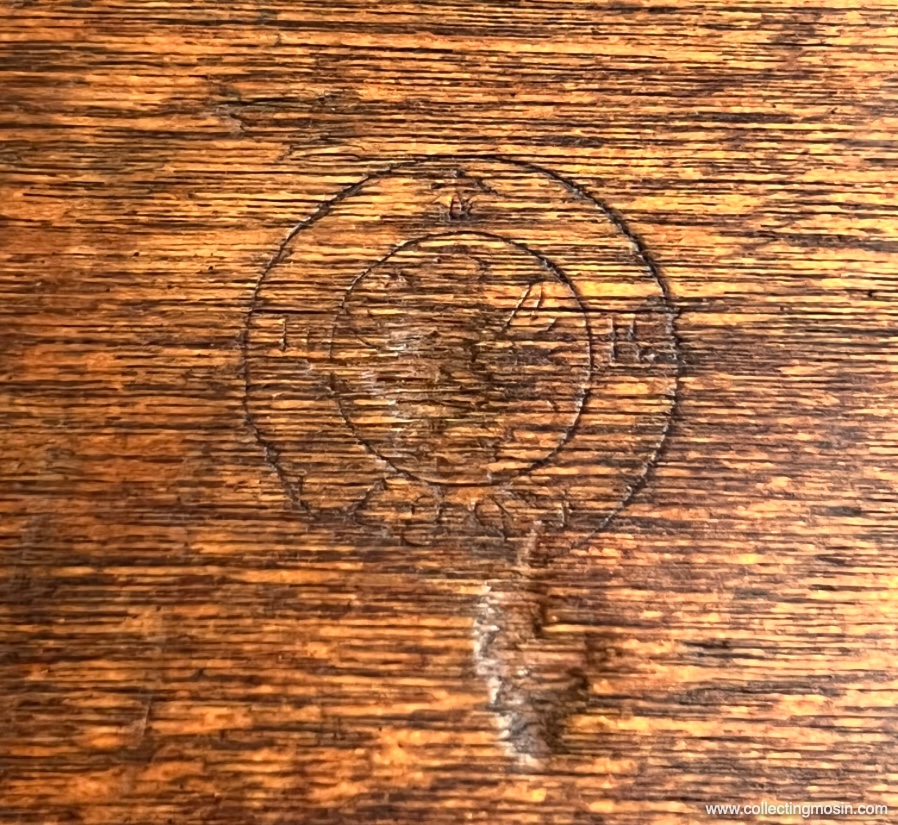
This Tula roundel is from 1899 and it has the standard markings in use before 1909, like the first one on the article. Moving forward from the stock, we will find the bolt assembly. It is generally marked in each part by the Arsenal, like the one below from the Imperial era.

The first marked part is the cocking piece (above), then the bolt handle (below).

A Tula hammer mark can be found also on the connecting bar.

Moving forward on a Tula rifle of that period, we will find markings on receiver and barrel, like the different types below.

In the above picture, we have the barrel markings of a Tula M1891 from 1898. The serial number is below the year of production while above we have the following words: “Imperial Tula Firearm Factory”. The Tsarist eagle with the acceptance ПK marks are both on barrel and receiver. This is the way Tula Arsenal marked Mosin Nagant barrels and receivers from 1892 until 1912. You can find a very good example of a Tsarist era Tula Arsenal M1891 rifle in our Nations and Models section.
The Imperial Tula Arsenal Peter the Great markings: 1912 – 1918
In the first production of the year 1891, the Tula barrel was marked with a different font and style, then the marking in use changed to the one previously shown. About the barrel, another change started in 1912 with the introduction of a new style of markings due to the celebration of the Tsar Peter The Great, founder of the Arsenal, as mentioned before. This led to the following beautiful barrel marking, that is usually rare to find intact. This version, with a big Tsarist eagle, was in use from 1915 till 1918 while a version with a small eagle was stamped starting from 1912 till 1914.

Over the year of production we can find the new denomination: “Tula Emperor’s Peter the Great (Peter I) Firearm Factory”. About the receiver, the eagle changed into the one depicted below.

Moving under the barrel to the magazine, we will find the Tula hammer and the acceptance markings. The serial on the barrel is usually stamped also on the magazine floorplate, as well as on the bolt and the butt plate (in the first years of production the serial number was stamped in the middle on the plate while later this will be applied to the upper part of the plate, under the Tula hammer mark).

Returning to the upper part of a Tula rifle, we will find the rear sight, that will be stamped with a Tula hammer like the one below.

The Tula hammer can be found on the leaf, like in the picture, or in the internal part, like shown below.
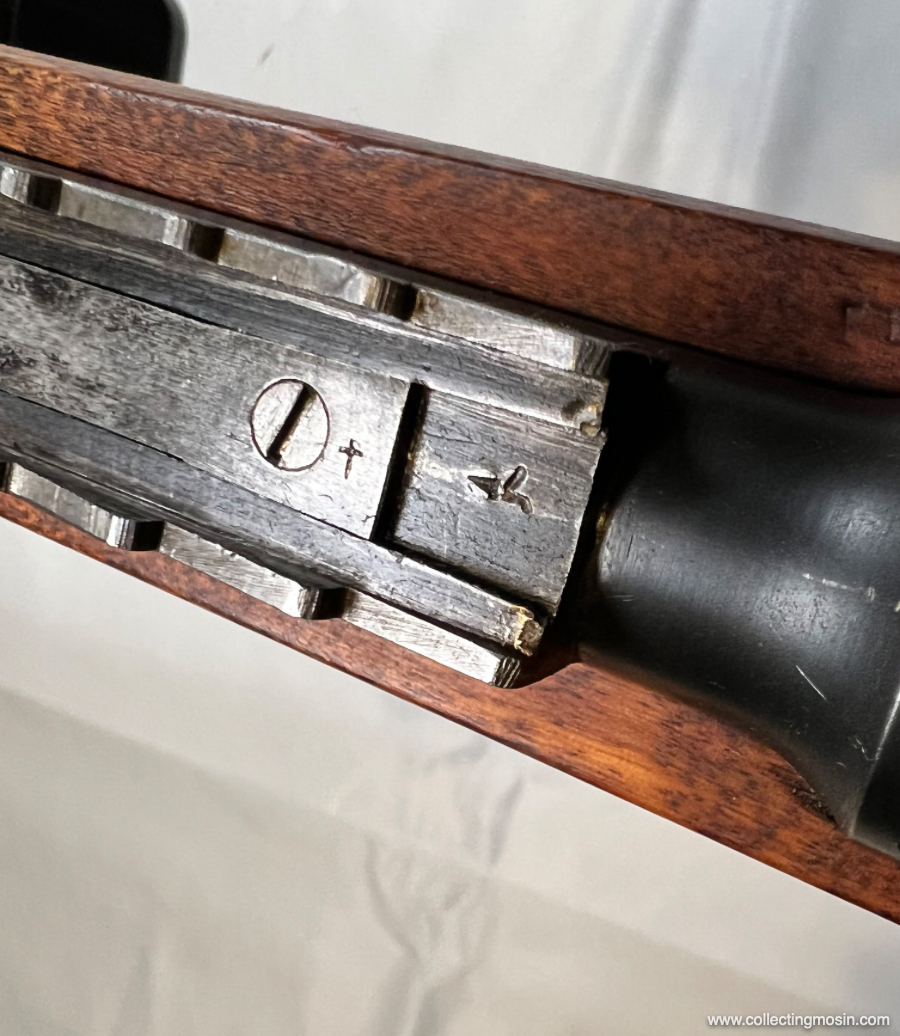
Then, moving forward along the stock, we will find other marked parts, such as the barrel bands, the nosecap and the cleaning rod.

Tula hammer on the rear barrel band is in the picture above, then below the same mark it is on the forward band and the nosecap.

The second type barrel band, so the one in use after the introduction of the wooden handguard at the end of 1894, included an attached sling swivel, like in the picture above. This part, that was in use before the introduction of the sling slots in the stock around 1908, was also marked with a Tula hammer.

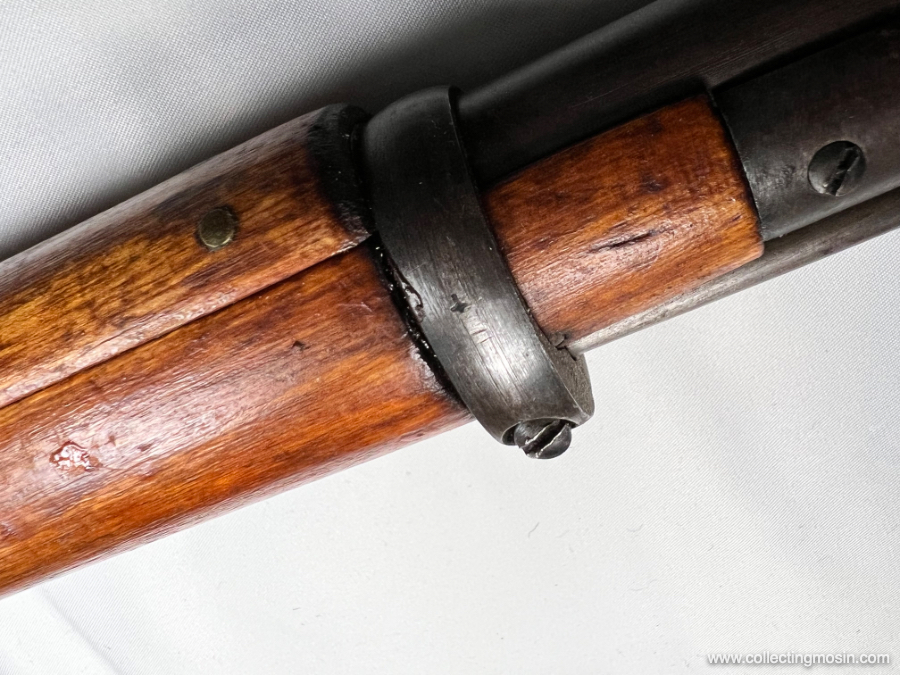
Tula made barrel bands of the first type, so the one in use when there were no handguards on M1891, are really rare, like rifles with that feature. The difference with the second type was the absence of notches to host the handguard’s metal pins. The third type barrel bands were basically identical to the second type ones but the sling swivel was missing. Third type was in use starting from the adoption of the sling slots in the stock around 1908. Then, starting from 1910, a fourth type band was adopted. This type is the one depicted below, from a 1917 Tula Peter the Great M1891 rifle.
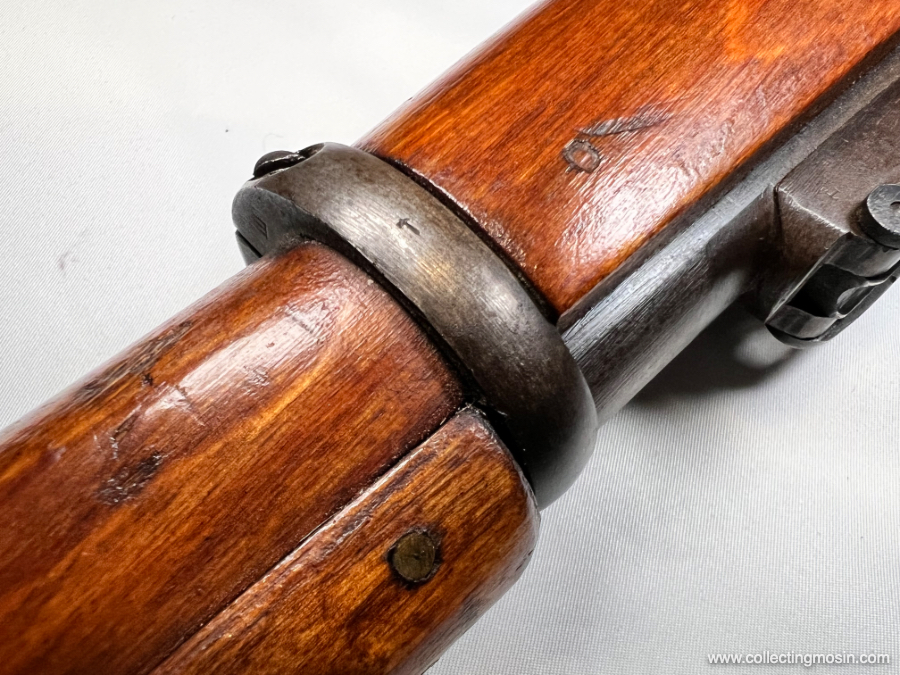
A rear barrel band of fourth type is depicted above while a front barrel band is below.
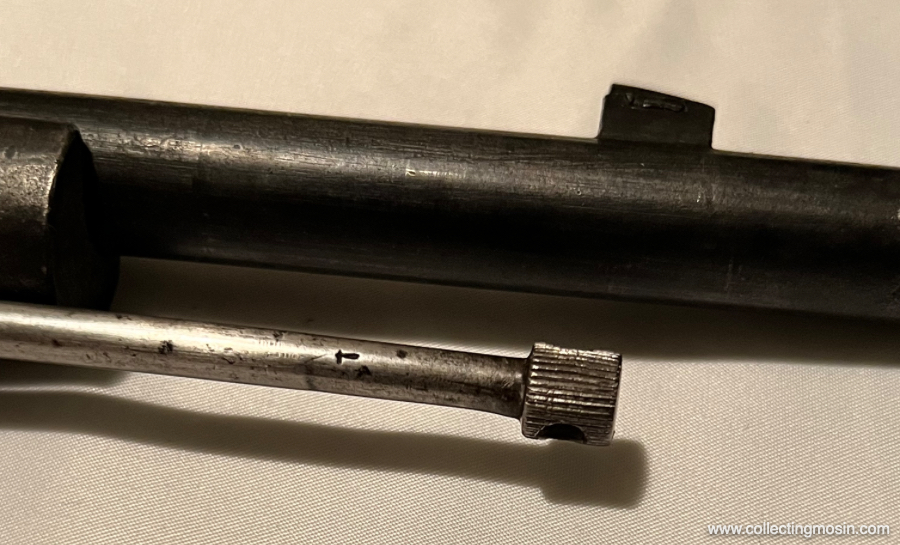
At the end, we have a Tula produced cleaning rod for the M1891 rifle, marked with the distintive hammer.
The first Soviet era at Tula: 1919 – 1928
Coming soon…

8 Responses
Great article, I found it very interesting. I have one made in 1916 from the Tula factory.
Thank you Leo! I am working on new contents i hope i will have the opportunity to add soon to complete the overview!
Thank you again!
What are the different identifying stamps under the receiver tang that identify it as an Antique receiver? I know a date is obvious, but I was told other stampings that are not a “date” also identify it as an antique receiver when no date is present.
Hi, yes stampings indicating a specific production are also a clear sign that the rifle has been produced before 1898, at least from the collectors point of view, since i don’t know how this specific topic is managed by the law in the States. Anyway, the most famous one is the Chatellerault production marking, the “c” in circle. Chatellerault Arsenal produced M1891 only from 1893 till 1895 so sure a receiver with that marking is qualifying it as an antique receiver.
Love the article, can’t wait on next era (Have a Soviet Era 1927 Tula, likely a so-called ex-dragoon” from year and markings.
Sadly, many have import marks (mine by a company in Summerville, SC). If appropriate/within the scope of your article, would you comment on how US importer marks might impact the collector value.
TY
Hello, thank you for your kind words! I am working to be back online with new Mosin soon!
About the import marks, in my opinion the presence of big modern marks like large text boxes on the receiver has a negative impact on the historical value of the object that is damaged on the original parts affected. Sure if i will find a super rare example having a similar import mark i will think about buying or waiting for some without that markings. Waiting for a better one sometimes could be the best option, considering that a lot of Mosin are out there, even between the rare variations.
Thank you again
Outstanding site,
I have a M91 Tula 1916 that has been in Finland with a VKT barrel 1942 date. I enjoy it very much and it’s my second Mosin rife; I usually collect Japanese rifles but that may change.
Hi Randall,
thank you for your kind words, i hope you will continue to collect Mosin! Also Japanese captured Mosin are out there…