


A rare Mosin Nagant M91 Dragoon Finnish conversion
As i said multiple times, between the different versions of the Mosin Nagant wide family of rifles, the Dragoon model is probably one of the most desirable and fashinating version. In this case we have a Dragoon rifle that was serving for long time in different Armies and one of the last Dragoon to be used. It is also a special rifle, as it was modified to be used as a close combat training/practice rifle in the Finnish Army.
The Finnish close combat training rifles
Starting in the ’20s, the Finnish Army recognized the necessity to train soldiers in close combat and bayonet fighting. As a result of this, in 1926 about 652 Berdan II rifles were converted to this usage. These were second line rifles and almost useless on a modern battlefield so they were the obvious first solution. The conversion of the Berdan II consisted of applying a spring loaded rod, with a leather ball at the end, inside the barrel, that was also bored out. These Berdan II were used for training until the end of the Second World War, when the problem of replacing them emerged.

Above and below a Berdan II from my collection with the typical action.

In the picture below, from Markku Palokangas Military Small Arms Finland 1918-1988 volume 2, the close combat training practice conversion of the Berdan II.

To replace the Berdan II rifles some studies were conducted in the ’50s and in particular in 1957-1958 some second line rifles were examinated for possible conversions. Finnish depots were still full of Mosin Nagant rifles and the solution was found in converting the Dragoon variant. In 1959, 1500 Dragoons were converted to be used as close combat training rifles, like the one i am presenting below. The conversion included the addition of a blank fire muzzle cover, designed to support a rubber bayonet that was secured to it and to the cleaning rod. This rubber bayonet was in reality a 29 cm long piece of solid rubber known as the model M66 bayonet. Part of the 1500 Dragoons were distributed to schools and training units while others went to the infantry divisions. The model M66 bayonet was also used on M39s, as some pictures are showing it on books. However, i found no info about extensive use of M39s as close combat training rifles. What is known is that already in the ’60s two things were clear:
1 – the rifles used in this kind of training were sustaining heavy damages, as well as the M66 bayonets, so a possible replacement or integration was also again needed;
2 – war and rifles were changing, moving to assault automatic carbines, so this kind of training was no more a priority and if needed this will require maybe a different approach.
As a result of these considerations, already in the ’60s, the remaining close combat training Mosin Nagant Dragoons were returned to Finnish Army Depots from schools and units. In addition to this, a new possible close combat training rifle was on development: in 1963 about 100 Mosin M28 rifles were converted by Asevarikko 1 (or Army Depot 1) in close combat carbines. These M28 were shortened to the lenght of an assault automatic carbine and renamed M63 training rifles. A new training bayonet was also developed for these short M28 / M63 close combat rifles, that you can see in the picture below.

However, after the M28 conversion, apparently these M63 carbines saw little or no usage . About the Dragoons, a large portion of them were scrapped and the remaining few examples in the depots were retired officially from Army armaments in 1988. The one presented in this article is so one of the few rare Finnish Army close combat training Dragoon rifles surviving until today!
A survivor: from 1926 until 2024
This Dragoon rifle has been made by Tula Arsenal in 1926 and was likely in use in the Soviet Russian Army until at least the Winter War in 1939. It is weird that the rifle is not wearing any Finnish marking, for example a boxed SA or a D, so the only indication we have that is confirming the fact this was in use in the Finnish Army is the two-pieces stock and obviously the close combat conversion. It is also possible that this rifle was in so bad conditions when acquired by the Finnish Forces that the only possible usage for this weapon was the close combat conversion.


As shown above, the rifle has the following characteristics:
- Konovalov rear sight, in use since 1908 introduction of the new Spitzer bullet cartridges, so coherent with a 1926 produced Dragoon rifle;
- A Finnish two-pieces stock with typical Finnish metal sling swivel;
- one solid barrel band, standard for Dragoon rifles and one from an M91/30;
- all parts factory matching except for the bolt assembly;
- the rear part of the stock is likely from an M91/30 since the cartouche is an Izhevsk post-1937 one;
- the close combat training modification: a blank fire adapter and the M66 rubber bayonet.

Above the rear portion of the two-pieces stock, with an Izhevsk post-1937 cartouche.

The butt plate is the original one from the 1926 Mosin Nagant Dragoon. It is marked with the Tula hammer, correct for 1926 production and the serial is matching the barrel. In this case, since rifles in bad conditions were the one selected for the conversion, it is likely that this Dragoon had a damaged stock that was simply replaced with another one Finnish made, while using all the other parts of the original rifle. Moving forward from the butt plate, we can observe the bolt assembly, that even if it is not matching, has some parts produced at Tula. However, the Tula star was in use after 1928 so it is not coherent with the original rifle.

The serial that you can see below is not matching the one on the barrel, as in this case the bolt is the only part of the rifle mismatching and it is likely composed by a mix of parts deriving from multiple rifles.
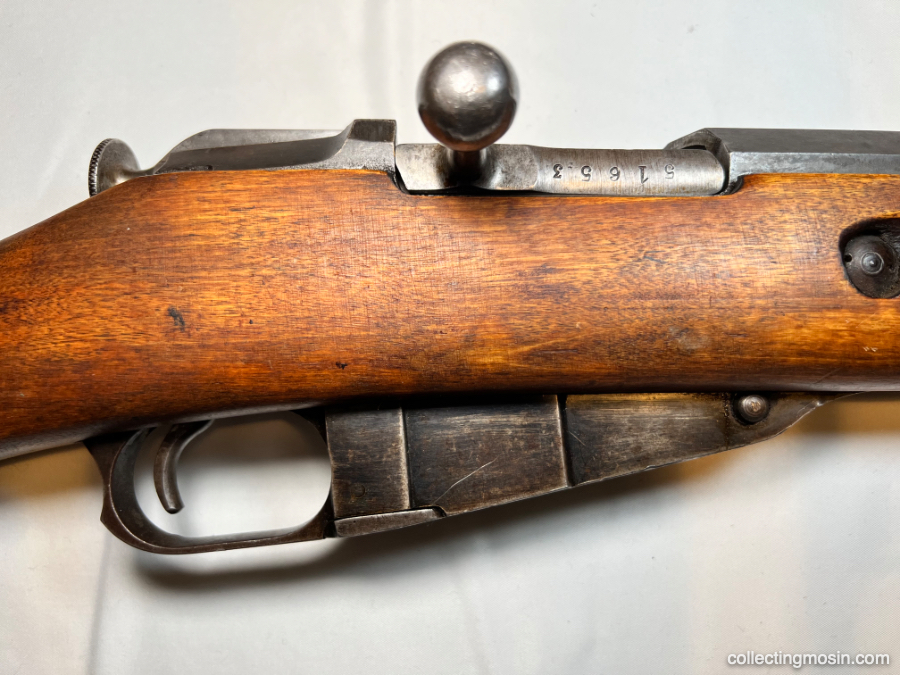
While this rifle was clearly modified and refurbished in some way, this was not altering the original finish and the blueing. The internal part of the receiver is still in the original in white metal finish.

Below you can see the markings on the barrel: the Tula star with the written (transliterated) “pervii oruzheinii zavod CCCP Tulskii” so the “first firearms factory of the USSR of Tula” and the year of production: 1926. This way to mark the barrel was in use between 1923 and 1928. In 1926 there was also a change in the way to mark the receiver: the Tula big hammer, in use since 1918, was replaced by a “wheat with hammer and sickle”, similar to the one in use at Izhevsk. Receiver markings will be eliminated in 1928.

In the following picture a close view of the “wheat with hammer and sickle” marking on the receiver.

So the barrel and receiver likely belongs to the same original Dragoon rifle from 1926, as the tang date is also matching.
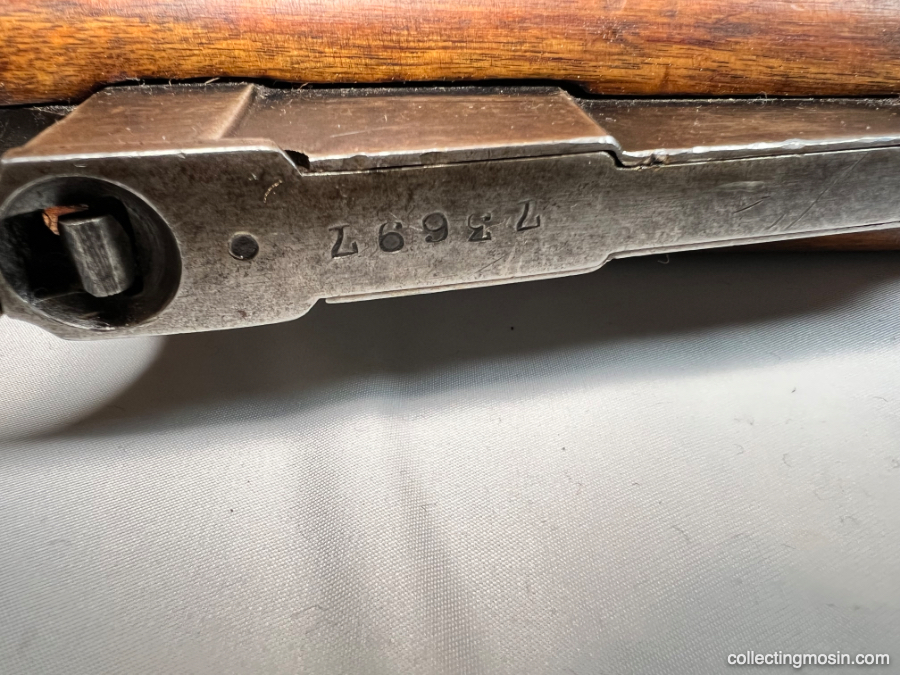
The magazine is matching as well, so it belongs to the same rifle like the butt plate. In the picture below you can see the typical division between the two pieces of the stock and the Konovalov rear sight. Moving forward, we can already appreciate the solid rear barrel band that is also typical to Dragoon and Cossack rifles.
Mosin Nagant rifles made from multiple others
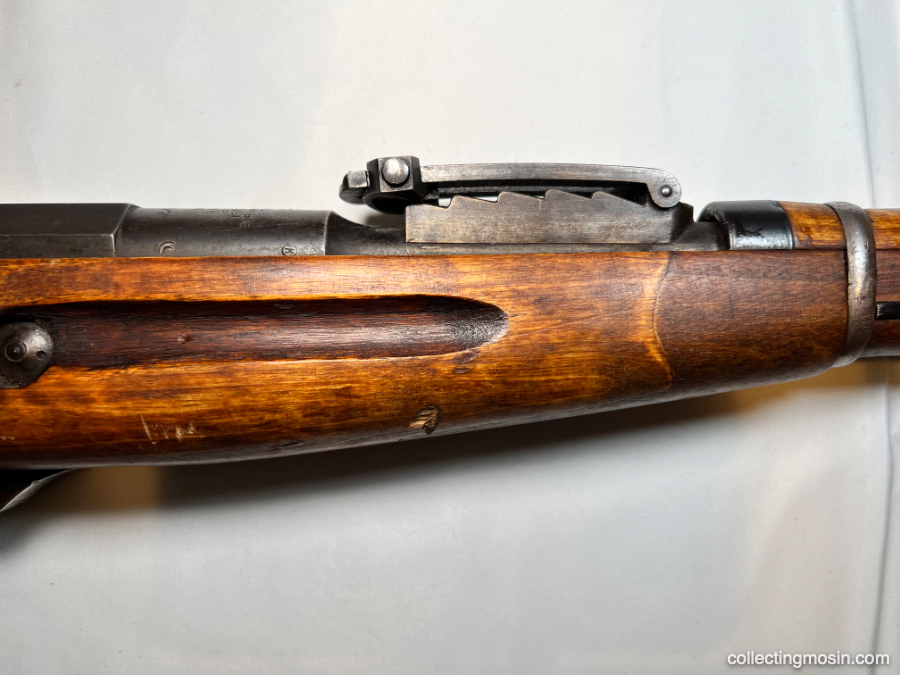
However, this solid barrel band is marked with the Izhevsk bow and arrow indicating that this part belongs to another Dragoon rifles. The marking is more clear in the picture below.
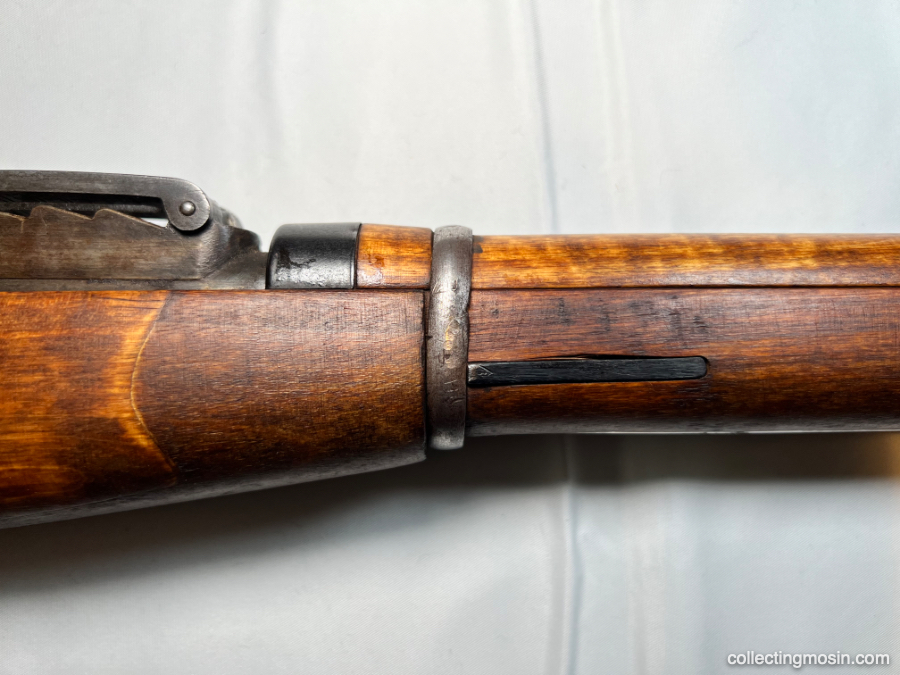
This is another proof that these close combat rifles were also assembled with parts from multiple rifles and the fact this Tula Dragoon remained close to matching is probably really just a rarity into the rarity of this kind of elusive version.
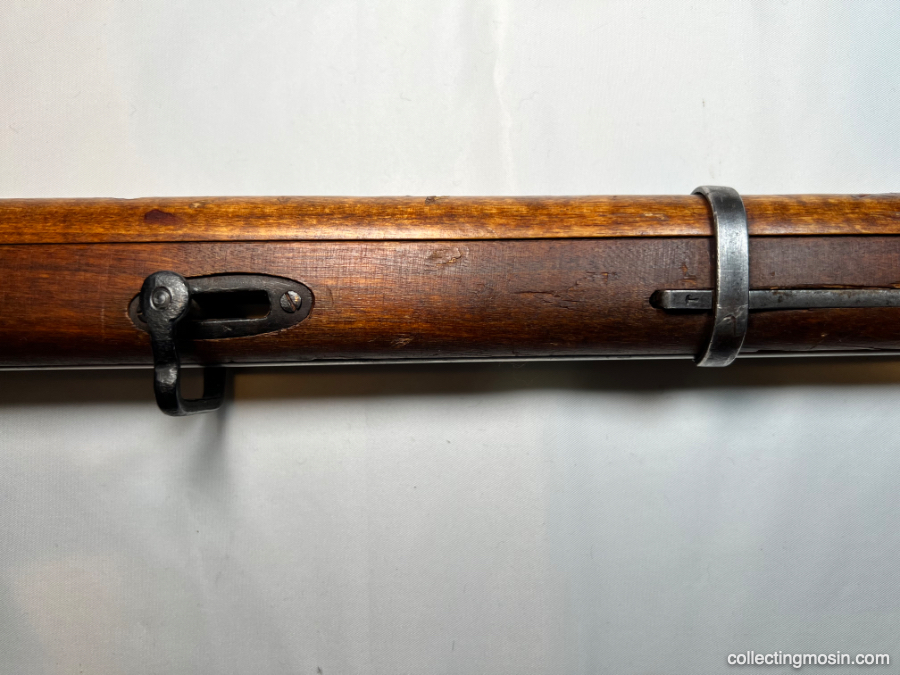
In the above picture we have the forward barrel band, that is from an M91/30 Mosin Nagant rifle, so not from a Dragoon even if the spring to retain it in place is marked with the Tula hammer in use until 1928. In addition to this, you can see a classic Finnish sling swivel, in this case moving inside the original sling slot. In the picture below, the rear sling swivel of the same style.

Moving forward also from the left side, we can observe the graduation in hundreds of arshini (4-6-8-10-12) on the Konovalov rear sight, while a capital H is stamped in the finger groove on the stock. If you want to understand the graduation on the sight and apply a conversion, 400 arshins are equal to 284,5 meters.
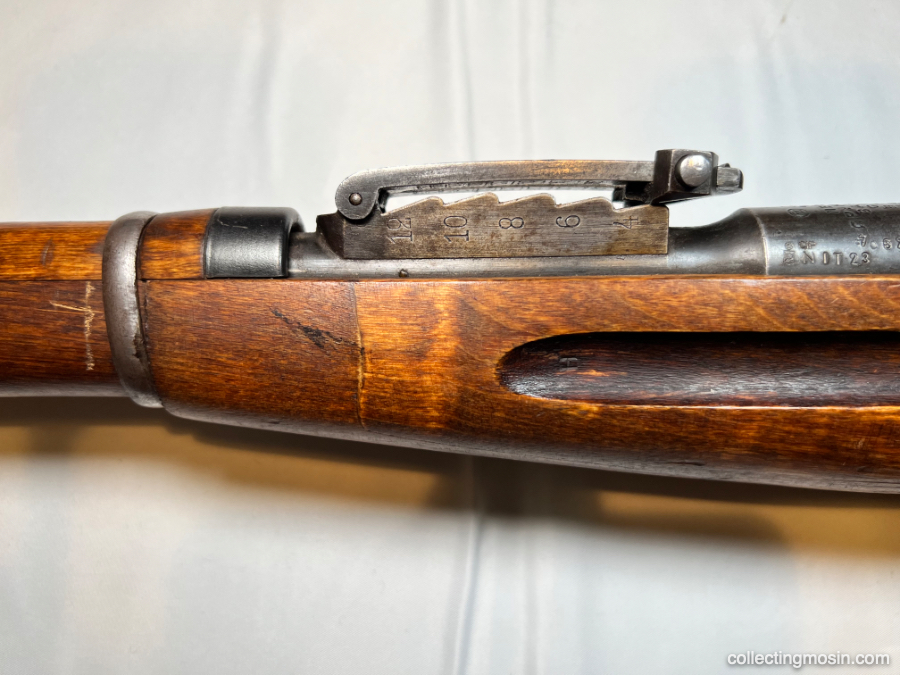
The finger groove is also hosting another unknown marking: a big triangle close to the crossbolt. The meaning is currently unknown and this is the first Mosin i observed with this mark.

Finally, appoaching the muzzle, we can see the modification that is characterizing the close combat training version: in the picture below the left side of the blank fire device with the M66 bayonet attached to it and the cleaning rod. The blank fire adapter was used to break the wooden bullet that the Finnish Army used on the training cartridges.
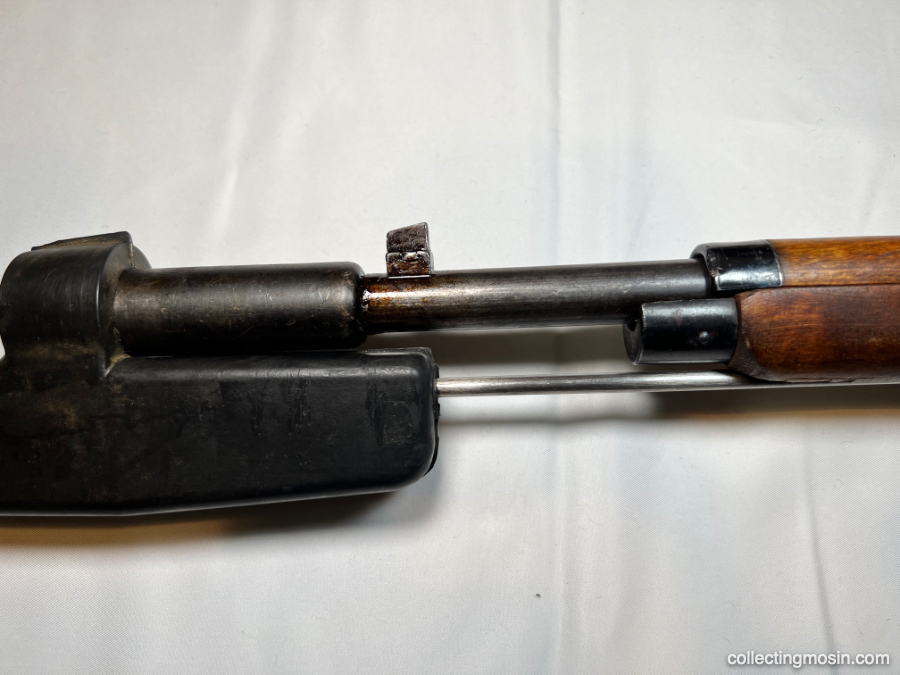
While the left side of the blank fire device has no holes, these are present on the right side, as you can see below. Another important feature, that we can see in the picture, is the marking on the model M66 rubber bayonet: all of these are marked with the number 6550 on the right side while some have also the boxed SA marking.

The shape of the M66 is clearly visible below. These rubber pseudo bayonets are really rare and complete rifles are obviously super rare.

Below the left side of the model M66 rubber bayonet.
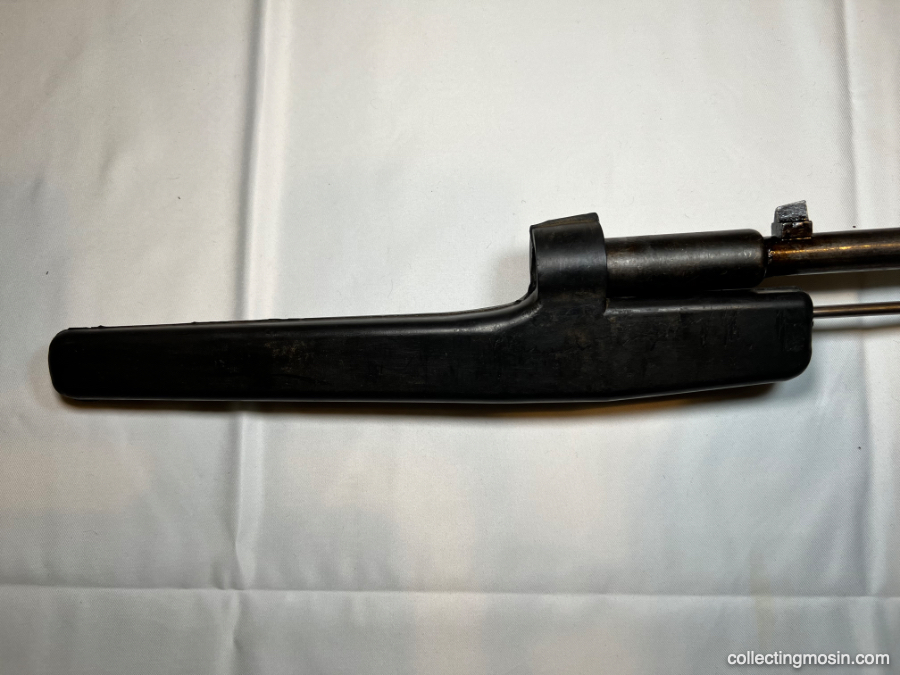
The modification to obtain a close combat practice Dragoon is completely removable, while the rifle is still shootable and the barrel, in this case, is in good conditions.

Disassembly the Dragoon close combat Mosin Nagant rifle
If we are disassembling this version, the first thing to do will be removing the M66 rubber bayonet and the cleaning rod. Here you can see the assembly.

We can also observe now how the cleaning rod is fixed to the M66.

Then we can move to the blank fire adapter that we will have to unscrew from the end of the barrel.

This device is completely closing and obstructing the barrel.

By removing it, we can see the muzzle with a quantity of preserving grease that was applied to it.

A Soviet Russia Mosin Dragoon ended up as a Finnish training rifle
Closing the analysis, looking at a possible connection of this gun with different users, it is clear that this Mosin Nagant M91 Dragoon rifle was likely serving in the Red Army before being captured / acquired by Finnish Forces. The fact that some parts were damaged probably prevent this rifle to be issued by the Finnish Army before the end of the Second World War. It is also possible this Dragoon was in the batch of rifles that Finland received from Germany in 1944. It seems that a lot of them were in poor conditions and impossible to use, except as sources of spare parts. This could be also a reason for the absence of Finnish markings like the boxed SA or the D i found on other Finnish captured Dragoons of my collection. If you want to know more about the Finnish markings on Mosin Nagant, please visit the dedicated page: https://collectingmosin.com/finland/
A very rare Finnish Mosin Nagant variant
In conclusion, considering that only 1500 Dragoons were converted to close combat training rifles and a great number were damaged and scrapped, likely very few survived and having a complete one in this conditions is really great. This very rare example really deserves the first special video on my YouTube channel! I hope you will enjoy it.

