


A fashinating M91 Dragoon in original conditions
Between the different versions of the Mosin Nagant wide family of rifles, the Dragoon model is probably one of the most desirable and fashinating version. Dragoon rifles were designed to be used by mounted infantry: basically these troops were not operating like cavalry but they will move rapidly mounted and then fight dismounted on the field, using a special variant of the Mosin M1891 rifle, the Dragoon version. This version, as the infantry rifle, was intended to be used with the bayonet installed. This is very important to remember, expecially at the shooting range. The Dragoon was lighter and shorter than the M1891 infantry rifle and this made this version suitable to be trasported and used by mounted troops. The rifle I am showing in this article is really special because it is almost in original conditions, like it left the Izhevsk Factory 107 years ago, in the middle of WWI.


As shown above, the rifle has the following characteristics:
- Konovalov rear sight, in use since 1908 introduction of the new Spitzer bullet cartridges, so coherent with a 1916 produced rifle;
- solid barrel bands, standard for Dragoon rifles;
- second type handguard for Dragoon rifles, again coherent with the year of production.
- all parts are factory matching except for the bolt assembly, that is, however, an Imperial Izhevsk production bolt with very interesting features i will describe in the article;
- an original stock with a great condition cartouche, that you can see in the picture below.

Starting from the rear portion of the stock, it has sling slots, correct for 1916 production and it is wearing a fantastic Izhevsk Arsenal cartouche, still intact and in very good shape.

The Izhevsk “bow and arrow”, the Arsenal logo and marking, is above the Tsarist eagle with the year of production devided by her. Izhevsk Factory produced Dragoon rifles from 1893 until 1932. Under the eagle, we can see the Russian Proof Commission acceptance mark П.

Under the rear part of the stock we can see a number 16 with a “bow and arrow” above (not easy to spot even in the picture), possibly indicating the year of production? It is the first time i am noticing this kind of particular on Mosin rifles. Anyway, the stock is original to the rifle, with the butt plate serial matching the barrel.

Mosin Nagant butt plate: a tip
The upper part of the rear/butt plate is showing the Izhevsk “bow and arrow” mark plus the rifle’s serial number. Usually, based on my experience, if the butt plate is factory matching (so the serial number has the same font and characters of the barrel, is from the same era and has coherent style and prefix, if any) so it is not simply reserialled to the barrel after a refurbishment process, it is highly likely that the stock is the original one that the rifle recieved at the end of initial assembly. On imperial M1891 you can also crosscheck this removing the butt plate and checking if under it there are numbers stamped on the wood. Usually, last two digits of the year of production of the stock can be found there. I found enough evidences about this stock so i did not unscrew the butt plate but i disassembled the rifle, as i always do after i am buying a new Mosin, and i even found the last three digits of the serial (627) written inside the forward part of the stock:

Moving forward from the butt plate, we can observe an early way to stamp the serial of the rifle on parts, a so called early feature that was still in use until 1917. In this case, we can see the serial number on the back part of the cocking piece.

This feature is really interesting: the serial is not matching the one on the barrel, as in this case the bolt is the only part of the rifle mismatching but, even if is not matching the barrel, the bolt is fully marked Izhevsk and it is an early type, coherent with the era of the rifle. What is particular is that the bolt has a secret itself: the cocking piece serial is 184680 (with the 1 stamped upside down) and the bolt handle flat side serial is 184679… so a difference of 1 rifle! This lead me to speculate if this bolt was or was not really put together even in the Arsenal or at a repair unit.

All the bolt parts are marked with the Izhevsk “bow and arrow”, a simbol that will be used by the Izhevsk Arsenal until 1928. Cocking piece is below.

Then the bolt handle section and the extractor are showing the “bow and arrow” mark.

And finally the bolt head below.

The central part of the rifle is showing features coeherent with the year of production. In the finger groove we can find the crossbolt, that has been introduced in late 1909 to reinforce the stock due to the introduction of the new ammunition (spitzer cartridge), so a standard feature in 1916. Then, a magazine without a sling swivel: correct, due to the fact that Dragoons never used this kind of configuration. In fact, already in the first production of 1893, Dragoon rifles, unlike M1891 infantry rifles, were equipped with sling slots in the stock from the beginning. In addition to this, Dragoons never had the finger rest.

A Dragoon in 1916 factory conditions
Moving a little bit further, we will find the Konovalov rear sight, again correct for a 1916 rifle, since this sight has been introduced in 1908, with spitzer rounds.

The receiver is showing the Imperial eagle mark in the standard Izhevsk style of that period. This eagle differ from the one stamped at Tula and you can check the difference looking at our markings and proof section.

The barrel markings are in the original shape, as the rifle has not been reblued. On the right side of the barrel an unusual marking is represented by a capital “B” in circle.

In Karl Heinz Wrobel “Drei Linien” vol.2 book and recently by “Mosin Museum” channel on YouTube, this marking has been classified as a possible indication of a barrel replacement that occurred to the rifle. In my collection i have another Mosin with this marking: a so called “St. Petersburg Cavalry School” carbine (i am convinced this is in reality a Romanian model of Cavalry carbine but i am still investigating) also with an Izhevsk made barrel. Now, what is clear to me is that this mark exclusively belongs to the Izhevsk Factory, because, at present, it has been observed only on Imperial Izhevsk made barrel in the same location. The fact it could indicate a barrel substitution is not matching the case of my 1916 Dragoon. In fact the receiver is highly likely the original one that was assembled with the barrel, at least looking at the date under the tang.

Obviously we cannot esclude that during the same year that receiver was assembled with another barrel (the current one), different from a possible initial one but unfortunately we have no other indications of this possibility. Anyway, the barrel is shiny and in very good conditions.
So, even if i can support the meaning of the “B in circle” as a rebarelling proof mark, i think this Dragoon is not supporting this theory. So i am currently evaluating to add this marking to the currently unidentified section.

The markings on the barrel are the classic ones used by the Izhevsk Arsenal until 1917, when the Soviet Revolution started. Under the serial number we can find the classic Izhevsk “bow and arrow” then, over the serial, the year of production. At the end of the year 1916 you can see an “r.” that translitterated would be “g.” for “god” that means “year”. Above the year of production we have three words that mean “Firearms Factory of Izhevsk”. Before going to the rear sight, you can see below the Tsarist eagle on top of the barrel. Just under the eagle the letter П (P) is the known acceptance marking of the Russian Proof Commission.

A KAB. marked Konovalov rear sight
As you can see above, the leaf of the Konovalov rear sight has diffrent markings: the usual Izhevsk “bow and arrow”, that is visible also in the internal part of the sight, the letter Ю (U), with an unclear meaning (possibly an inspector marking), and the KAB. mark. KAB. marking, that translitterated would be KAV, can be explained, according also to different collectors forums, as follows: since Dragoon rifles were aimed with the bayonet and intented to fire always with the bayonet in place while the Cossack rifles, basically identical to Dragoons, were setup to fire without the bayonet, in order to distinguish the two types of sights assigned to these rifles, the Cossack sight leaf was marked KA3 or KAZ (abbreviation for Казачья/Kazachya – Cossack) and the Dragoon sight leaf received the KAB marking or KAV (abbreviation of Кавалерия/Kavaleriya – Cavalry). I concur. Original matching and untouched Dragoons produced after 1908 have the rear sight leaf marked in such way. That is a fact.

The internal part of the rear sight is Izhevsk marked, as said before.

The right side of the rear sight is unmarked, as in the picture below.

Another detail that make this rifle special and original is the presence of an intact second type handguard, that is clearly visible above. Before the introduction of the Konovalov sights, the Dragoon rifles were using the first type flat sights, that were sorrounded by a wooden first type handguard, marked with the graduation in Arshin. First type handguard were really fragile and find today an orginal Dragoon rifle still wearing the pre-spitzer ball sights and a first type handguard it is extremely difficult. These are super, super rare.

Second type handguard is coherent with a 1916 production it is carachterized by a metal rivet/insert on each side and the shape that is hugging the frontal part of the rear sight.

The left side of the sight is stamped in hundreds of Arshin (4, 6, 8, 10, 12). 400 Arshini are 284,5 meters, so you can easly convert the distances. Before the “4” we have a capital “R” with an unknown meaning, while after the “12” the rear sight is stamped with the Izhevsk “bow and arrow”.

Under the central part, we can find the magazine with the floor plate that is matching the barrel. The forward edge of the magazine block is Izhevsk marked. A small capital “R” is close to the “bow and arrow” mark but also in this case the meaning of this letter is unknown.

A Mosin Nagant Dragoon rifle marked Izhevsk in every part
The barrel bands in use with Dragoon rifles were distinctive and of a single unique type. You can easily distinguish these from the M91/30 type bands (that will also fit) because the Dragoon’s bands are solid without any adjustment system. They are retained in place by springs in grooves along the stock.

Both bands and springs are Izhevsk marked.

Passing the front barrel band, the next marked part is the nose cap.

The nose cap is not marked on the frontal part but on the left side. Front sight is a typical blade type that is another characteristic of Dragoon rifle compared for example to the evolution of this rifle that will be the model of 1930 or M91/30.

A close view below.

Before closing the analysis looking at a possible connection of this gun with different users, there is a surprisingly small Izhevsk marking i would like to show you and it is the one on the sling slots on the stock!

The rifle has no clear connection outside Russia. This means that there are no markings indicating this rifle has been used outside the Imperial Russia Army or the Soviet one. This rifle has been imported directly from Finland but no Finnish markings or traits are present at all.

Above you can see the Italian import markings while the “П in oval” mark is the proof of the black powder test that the barrel passed during production.

An original very rare Russian Dragoon
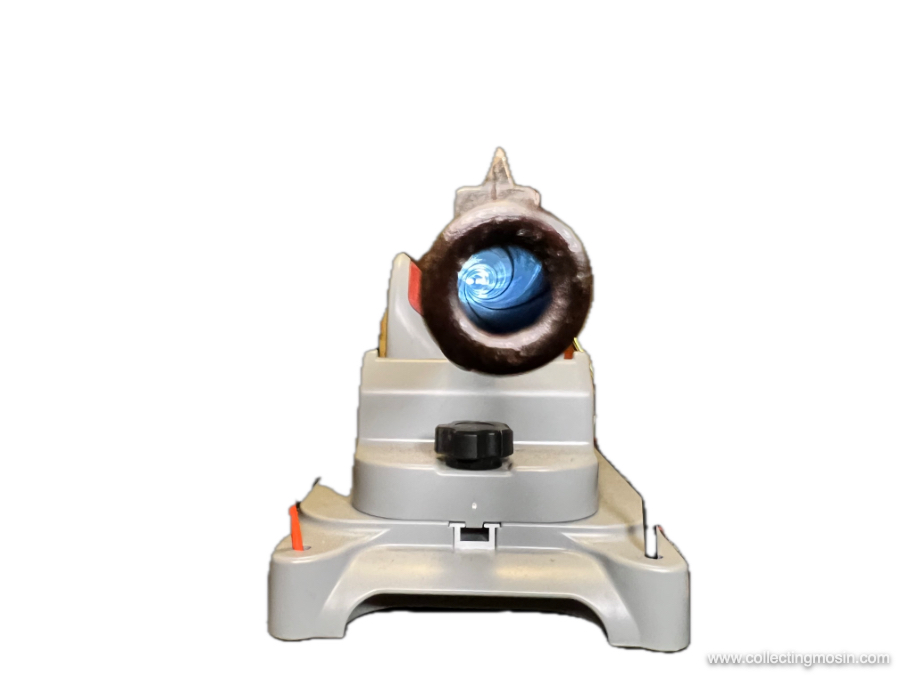
As we can see above, the internal part of the chamber is not blued, sign that this rifle never pass trought an extensive refurbishment process.
In conclusion, considering that this rifle is almost matching, there are no markings indicating usage outside Russia and conditions of wooden and metal parts are basically original, i will consider it as an example of an almost original Russian Dragoon. An example in this conditions, with the original marked stock, a very nice readable cartouche, the original second type handguard and the very nice patina without external refurbishement, is definetely very rare.

